A look at the week's most important housing, labor, and macroeconomic data — and what it means for buyers, sellers, and the broader economy.

A look at the week's most important housing, labor, and macroeconomic data — and what it means for buyers, sellers, and the broader economy.

This past week delivered a sobering batch of economic data that painted a picture of a housing market under siege and a labor market quietly fraying at the edges. Builder confidence slipped further in June, with more than a third of builders now cutting prices to move inventory, while Housing Starts cratered 15.4% month-over-month to their lowest level since May 2020 — the second consecutive month of steep declines. Building Permits followed suit, falling short of expectations with a particularly sharp 18.1% drop across the Midwest. Mortgage rates held at 6.60% as markets have largely abandoned hopes for a Fed cut, with nine FOMC officials now penciling in at least one rate hike to combat inflation pressures stemming from the conflict in Iran — a stark shift in tone under the new Fed Chairman Kevin Warsh. On the consumer side, Retail Sales beat expectations at +0.9% MoM, though much of that gain was driven by rising gasoline prices rather than genuine spending expansion. Pending Home Sales offered a rare bright spot, surging 3.8% in May as buyers appeared to grudgingly accept elevated rates as the new normal. The labor market, however, continues to tell a more troubling story beneath the headlines: jobless claims ticked higher for the fourth consecutive week, voluntary quits have fallen to pandemic-era lows as workers cling to jobs out of uncertainty, and the labor force participation rate dropped from 62.6% to 61.8% year-over-year — a recessionary-scale decline driven by workers exiting the workforce entirely rather than registering as unemployed. With real wages negative against 3.8% inflation and job growth concentrated almost entirely in healthcare, the underlying economic foundation looks considerably shakier than the topline numbers suggest.

The latest batch of economic data paints a concerning picture of rising inflation and cooling confidence. Consumer inflation expectations dipped ever so slightly to 3.5%, yet CPI surged to 4.2% in May — its third consecutive monthly increase — driven largely by a 23.5% spike in energy costs. Producer prices told a similar story, climbing to 6.5% year-over-year for the fourth straight month. That being said, MoM inflation seems to be slowing down. Small business optimism continued its slide, with the NFIB index hitting its lowest point since October 2024, as fuel costs and taxes squeeze margins. On the housing front, there was a bright spot: existing home sales rebounded more strongly than expected in May, up 3.6%, though mortgage rates ticked back up to 6.6% after a brief dip. Mortgage applications didn't care as the summer season kicks, surging 10.8% for the first week of June. Jobless claims remained historically low but crept higher for the third consecutive reading, a trend worth watching. Overall, the week's data reflects an economy under pressure — where energy-driven inflation is outpacing wage expectations and eroding both consumer and business confidence.

The U.S. economy sent mixed signals this week. Job openings surged to 7.618 million in April — far above forecasts — and May added a stronger-than-expected 172,000 non-farm payrolls, with unemployment holding at 4.3%. However, the quit rate dropped to its lowest since mid-2020 (1.9%), signaling worker anxiety rather than confidence, and wage growth of 3.4% year-over-year continues to trail the Fed's preferred inflation gauge of 3.8%, meaning most Americans are still losing ground in real terms. Initial jobless claims rose to 225,000 — the highest since February — though continuing claims ticked down slightly, suggesting re-employment is still happening. On the housing front, mortgage rates eased to 6.57%, but applications fell for a third straight week, pointing to persistent affordability concerns. The overall picture is an economy that looks solid on the surface but faces mounting pressure from inflation, geopolitical costs tied to the Iran conflict, and a consumer base quietly stretched thin.
The housing market is showing clear signs of cooling, though demand hasn't evaporated — it's just stalling. Five consecutive weeks of rising mortgage rates (now at 6.65% per the MBA) are doing the work the Fed hoped for, slowing what had been a prolonged seller's market. Mortgage applications fell 8.5% in the latest week, following a 2.3% drop the week before — not surprising given the rate environment.
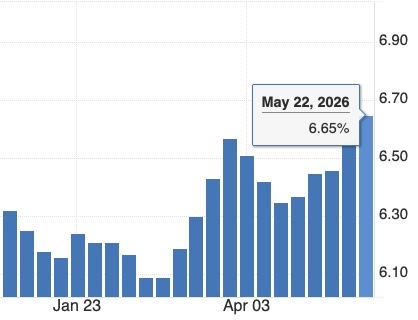
The housing market is showing clear signs of cooling, though demand hasn't evaporated — it's just stalling. Five consecutive weeks of rising mortgage rates (now at 6.65% per the MBA) are doing the work the Fed hoped for, slowing what had been a prolonged seller's market. Mortgage applications fell 8.5% in the latest week, following a 2.3% drop the week before — not surprising given the rate environment.